MCAS (Mast cell activation syndrome) and Neurodivergence, what's the relationship and what can th...
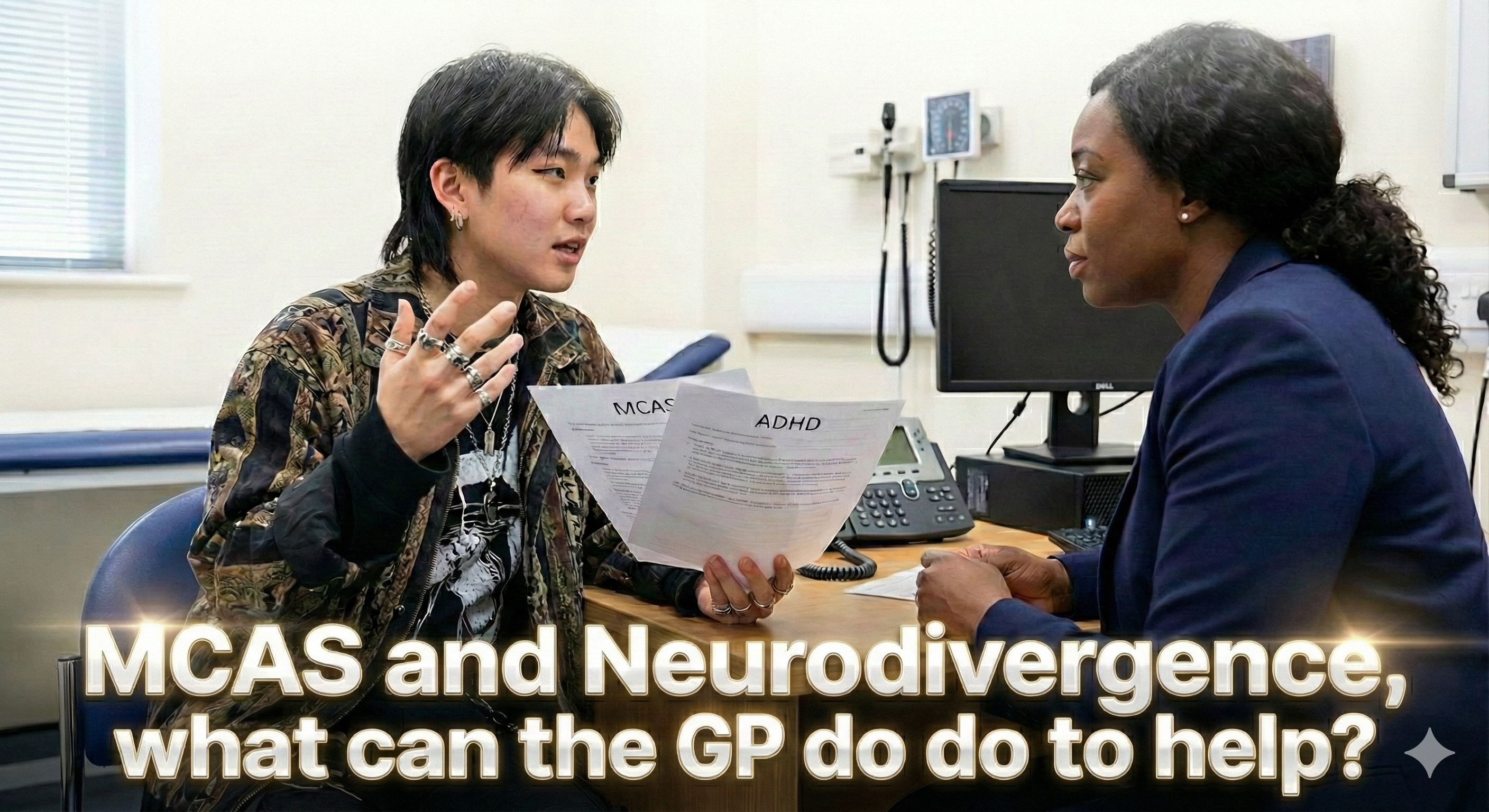
It's a Wednesday afternoon. A patient sits across from you, clutching printed articles from the internet. They've spent months researching, convinced they've finally found an explanation for the symptoms that have troubled them for years - the unexplained flushing, the brain fog that worsens after certain meals, the chronic fatigue that no amount of rest seems to fix. "I think I have MCAS," they say, "and I need to start a low histamine diet."
Does this sound familiar?
More patients and clinicians are talking about the link between Mast Cell Activation Syndrome (MCAS) and neurodivergence. For those of us who work with neurodivergent patients, understanding this emerging - and often controversial - area helps us provide better, more compassionate care.
Understanding MCAS
Mast cells are white blood cells found throughout the body, especially in tissues that meet the outside world - the skin, airways, and gut. They play a key role in immune responses, releasing chemical messengers like histamine, tryptase, and prostaglandins when triggered. In healthy people, this system helps fight infections and responds to allergens.
In Mast Cell Activation Syndrome, these cells become overactive. They release their chemicals too easily or too much, in response to many different triggers - foods, temperature changes, stress, hormonal shifts, or sometimes nothing obvious at all. This causes symptoms that can affect almost any part of the body and often come and go unpredictably.
Common symptoms include skin problems like flushing, hives, and dermographism (skin writing); gut symptoms like abdominal pain, diarrhoea, and reflux; heart symptoms like palpitations and lightheadedness; breathing difficulties; and brain symptoms like fog, headaches, and anxiety. Researchers first described the condition in 1991 and proposed diagnostic criteria in 2010.
The neurodivergence connection
New research points to links between MCAS and neurodivergent conditions, though we don't yet fully understand this relationship. Dr Jessica Eccles, a consultant psychiatrist and researcher at Brighton and Sussex Medical School, has led important work on brain-body connections in neurodivergent people. Her research shows that neurodivergent people are more than twice as likely as the general population to have hypermobile joints - and hypermobility often appears alongside MCAS and dysautonomia.
Her studies found that people with Ehlers-Danlos Syndromes are seven times more likely to be autistic and six times more likely to have ADHD than the general population. Recent research shows that 51% of neurodivergent adults have hypermobility, compared to 20% of others. Among neurodivergent women, this rises to 70%.
Clinicians now see the "triad" of hypermobility, dysautonomia (especially POTS), and MCAS more often, with neurodivergence frequently appearing alongside. Studies also show higher rates of inflammatory and allergic conditions in people with ADHD.
The brain symptoms common in MCAS - brain fog, memory problems, anxiety, and mood swings - look very similar to challenges many neurodivergent people face. Mast cells exist throughout the brain, and when they activate, they can affect how the brain works. Some researchers, including Professor Theoharides at Tufts University, suggest that mast cell inflammation in the brain may play a role in conditions including autism, though this work is still early.
The diagnostic challenge
Here we need to be honest with our patients: MCAS remains controversial and poorly defined. No NICE guidelines exist for diagnosing or managing it. The WHO has published criteria for mastocytosis, but not for MCAS, because people present so differently.
Two main diagnostic frameworks exist - Consensus 1 and Consensus 2 - each with pros and cons. This shows how hard it is to create guidelines for a condition that affects so many body systems in so many ways. The UK Mastocytosis Support Group notes that MCAS "suffers from insufficient recognition in the UK medical system" and lacks the ICD-10 code that the United States has assigned it.
Testing creates particular problems. Ideally, we would show raised mast cell chemicals during symptomatic episodes. But specialist tests are not yet widely available on the NHS. Tests for urinary prostaglandins and N-methylhistamine mostly exist only in private labs, and results can come back normal even in affected people if we don't catch them during a flare.
In practice, many UK clinicians take a pragmatic approach: they take a careful, thorough history, rule out other diagnoses, and watch how patients respond to a trial of antihistamines or mast cell stabilisers. A good response to these medications supports the diagnosis, though it doesn't prove it.
The appeal of an explanation
For neurodivergent patients who have often spent years feeling unheard and dismissed, discovering MCAS can feel like a breakthrough. Here, finally, is a framework that might explain the chronic fatigue, the food sensitivities, the reactions that seem out of proportion to their triggers. Online communities offer validation from others who understand.
This search for answers makes complete sense. Research shows that neurodivergent people often have worse health outcomes and wait longer for diagnoses. Finding a possible explanation for symptoms that doctors have minimised or blamed on anxiety can feel profoundly validating.
But this very appeal can sometimes lead patients down paths that don't serve them well - especially when it comes to diet.
The low histamine diet: promise and peril
The most common thing patients research before coming to see us is the low histamine diet. The logic seems simple: if mast cells release too much histamine, eating less histamine should help. The "histamine bucket" theory - that symptoms appear when total histamine overflows the body's capacity - has spread widely in patient communities.
But the evidence is thin. The British Dietetic Association notes that "there are no large-scale, high-quality clinical trials to date that look at the dietary intake of those with MCAS." A systematic review found only one study had looked at restrictive low-histamine diets in mast cell disorders, and concluded that "no clinical studies in humans had provided substantial evidence of a mechanism of histamine release in certain foods."
More importantly, histamine is just one of many chemicals mast cells release. Focusing only on dietary histamine may miss what actually triggers individual patients.
The risks of restriction
For neurodivergent patients, strict elimination diets carry risks that people often underestimate.
Many autistic people have strong sensory preferences around food. A low histamine diet may mean giving up "safe foods" - those few foods the person can reliably eat and enjoy. When safe foods go, people skip meals or eat less, which can lead to malnutrition.
Executive function challenges, common in both autism and ADHD, make strict low histamine eating very hard. You need to prepare fresh food daily or freeze it immediately; leftovers build up histamine and become problematic. The meal planning, shopping, and constant vigilance can overwhelm someone already struggling with daily demands.
The British Dietetic Association has seen worrying patterns in practice: low body weight, weight loss, and nutrient deficiencies from restricted diets. These happen whether from removing confirmed triggers, trying elimination diets to find triggers, or simply because symptoms make cooking, shopping, and eating too hard.
There's also a psychological toll. Some people develop orthorexic patterns - an obsessive focus on "pure" or "safe" eating. Fear of triggering symptoms can become so overwhelming that the diet itself causes significant anxiety and isolation.
When hope becomes harmful
The most delicate issue comes when patients hope that strict dietary management will eliminate their neurodivergent symptoms - that the brain fog will clear, the sensory sensitivities will resolve, that they'll finally feel "normal."
This hope makes sense, but it can lead to deep disappointment. Mast cell problems don't cause neurodivergence, even if the two occur together and interact. No amount of dietary restriction will make someone no longer autistic or no longer have ADHD. When the hoped-for transformation doesn't happen, patients may restrict further, convinced they haven't been strict enough. This can spiral into increasingly limited and harmful eating patterns.
Mast Cell Action, the UK charity supporting people with mast cell diseases, advises that "not everyone with MCAS will benefit from such a diet." They recommend trying a low histamine approach "for a short period, typically two weeks. If there's no noticeable improvement within this time, it might not be worth continuing." They stress avoiding food restrictions "unless absolutely necessary" and suggest "histamine modification" rather than strict elimination - a more flexible approach that adjusts to individual tolerance.
A practical approach in general practice
Without clear guidelines, what can we offer our patients?
Validate first. Acknowledge that their symptoms are real and that researchers increasingly recognise possible links between neurodivergence and physical symptoms. Dr Eccles and others are starting to understand these brain-body connections, even if clinical pathways haven't caught up yet.
Talk honestly about uncertainty. Be open that MCAS remains controversial, that experts debate the diagnostic criteria, and that the NHS has limited pathways for assessment. Patients deserve to understand what we know and don't know, rather than false certainty either way.
Try a pragmatic treatment trial. Where symptoms suggest MCAS, trying H1 and H2 antihistamines carries little risk and may help with diagnosis. Fexofenadine and famotidine work well. A good response supports the clinical picture, though no response doesn't rule MCAS out.
Be cautious about dietary restriction. If patients want to try dietary approaches, encourage a time-limited trial rather than indefinite restriction. Recommend dietetic support - though acknowledge this can be hard to access on the NHS. Stress that dietary changes should never eliminate all safe foods for sensory-sensitive people, and that restriction without clear benefit should stop.
Look at the whole picture. Remember that MCAS, if present, may be one piece of a larger picture including hypermobility, dysautonomia, and neurodivergence. Dr Eccles's Neurodivergent Brain-Body Clinic at Sussex Partnership NHS Foundation Trust shows what integrated care could look like, though such services remain rare.
Know your referral options. NHS allergy and immunology services face heavy pressure and may have limited MCAS experience. Some regional pathways will only assess suspected MCAS if patients meet mastocytosis criteria. Knowing local resources and their limits helps set realistic expectations.
The bigger picture
The story of MCAS and neurodivergence tells us something about the gaps in our healthcare system - conditions that fall between specialties, patients whose complex problems don't fit existing pathways, emerging science that hasn't yet reached clinical guidelines.
For neurodivergent patients navigating this landscape, the experience can be particularly hard. Many have already faced years of having symptoms minimised or blamed on anxiety. The lack of clear diagnostic pathways can feel like yet another form of medical gaslighting.
We can't fix these systemic problems in a ten-minute appointment. What we can do is hold space for uncertainty honestly, validate real symptoms without overpromising solutions, protect patients from potentially harmful interventions done without proper support, and advocate for better research and clearer pathways.
As research continues to untangle the complex connections between connective tissue, immune function, autonomic control, and neurodevelopment, clearer answers may come. Until then, our job is to walk alongside our patients in the uncertainty - neither dismissing their experiences nor endorsing approaches that may cause more harm than good.
The patient sitting across from you with their printed articles deserves to be heard, to have their symptoms taken seriously, and to get honest guidance about what we know, what we don't know, and what might genuinely help. That, perhaps, is the best care we can offer while the map is still being drawn.
Resources
Mast Cell Action (www.mastcellaction.org) - UK charity with patient information, resources for health professionals, and support services
The UK Mastocytosis Support Group - Information on mast cell disorders and diagnosis
PoTS UK - Resources on links between POTS, MCAS, and hypermobility
British Dietetic Association - Guidance on MCAS and diet
Royal College of GPs Ehlers-Danlos Syndromes Toolkit - Information on common related conditions
References
Csecs, J. L. L., Iodice, V., Rae, C. L., et al. (2022). Joint Hypermobility Links Neurodivergence to Dysautonomia and Pain. Frontiers in Psychiatry, 12, 786916.
Song, Y., Lu, M., Yuan, H., Chen, T., & Han, X. (2020). Mast cell mediated neuroinflammation may have a role in attention deficit hyperactivity disorder. Experimental and Therapeutic Medicine, 20(2), 714-726.
Theoharides, T. C., Kavalioti, M., & Tsilioni, I. (2019). Mast cells, stress, fear, and autism spectrum disorder. International Journal of Molecular Sciences, 20(15), 3611.
Afrin, L. B., Ackerley, M. B., Bluestein, L. S., et al. (2020). Diagnosis of mast cell activation syndrome: a global "consensus-2". Diagnosis.
Valent, P., Hartmann, K., Bonadonna, P., et al. (2024). Using the Right Criteria for MCAS. Current Allergy and Asthma Reports.
Hall, C. (2023). How can a dietitian help support those with Mast Cell Activation Syndrome? British Dietetic Association.
Kohn, A., & Chang, C. (2020). The relationship between hypermobile Ehlers-Danlos syndrome (hEDS), postural orthostatic tachycardia syndrome (POTS), and mast cell activation syndrome (MCAS). Clinical Reviews in Allergy & Immunology, 58(3), 273-297.
Vlieg-Boerstra, B. J., van der Heide, S., Oude Elberink, J. N., Kluin-Nelemans, J. C., & Dubois, A. E. (2005). Mastocytosis and adverse reactions to biogenic amines and histamine-releasing foods: what is the evidence? Netherlands Journal of Medicine, 63(7), 244-249.
Disclaimer: This article was drafted with the assistance of artificial intelligence as an adjustment for the author's own neurodivergence and reviewed and edited by the author. All content, opinions and recommendations reflect the author's professional expertise and judgement.